Getting Started: AI Access to ClayHR Data with MCP
MCP is the connection layer between ClayHR and the AI assistants your people already use. It allows employees, managers, and HR teams to ask questions about ClayHR data in plain language — from Claude, ChatGPT, or any MCP-compatible AI assistant — and receive answers drawn from live ClayHR data rather than exported spreadsheets.
Most HR questions are simple to ask and slow to answer. Finding out how much leave a team took last quarter, or whether this month's payroll contains an anomaly, usually means locating the right report, applying the right filters, and reading the result. MCP removes those steps. The question is asked in the AI assistant, and the answer comes back from ClayHR.
1. Understanding MCP in ClayHR
The Model Context Protocol (MCP) is an open standard that allows AI assistants to connect directly to the systems where business data is stored. Rather than being given a copy of your data, the assistant queries the source at the moment the question is asked.
ClayHR MCP implements this standard. Once connected, users can ask questions such as:
- How much leave has my team taken this quarter compared to last?
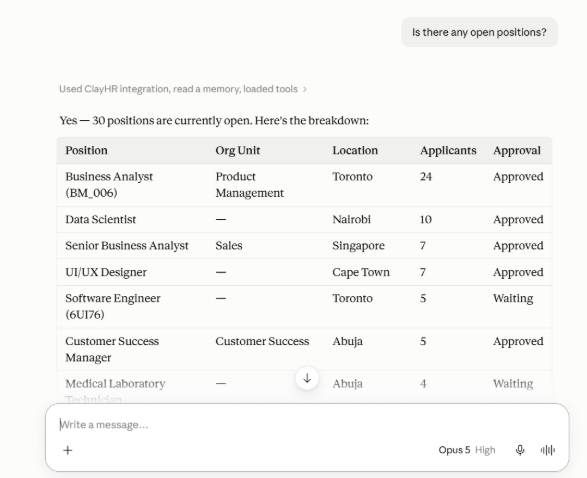
- Are there any open positions, and how many applicants does each have?
- Is there a payroll discrepancy this month?
- Who is overdue on compliance training?
MCP does not introduce a new data model. It provides access to the reporting layer that already exists in ClayHR, and the assistant names the report it used so the source can always be verified.
What MCP can reach
- Find reports — list and search the reports the user already has access to
- Read report data — read rows, columns, and totals from those reports
- Count and summarise — answer counts and breakdowns without exporting whole row sets
What MCP cannot reach
- Reports the signed-in user does not have permission to open
- Any create, edit, delete, or send operation anywhere in ClayHR
If information is not available to a user as a report in ClayHR, the assistant cannot answer questions about it. Where a team frequently asks questions MCP cannot address, the solution is usually to create or share the underlying report.
2. Permissions and Access Boundaries
MCP applies your existing ClayHR permissions to every request. It does not extend access, and it does not restrict it. An employee asking about compensation sees their own; a manager asking about their team sees their direct reports; an administrator sees what an administrator already sees in the product.
- Credentials are not shared with the AI provider. They are submitted to ClayHR during setup and encrypted at rest. The assistant never receives them.
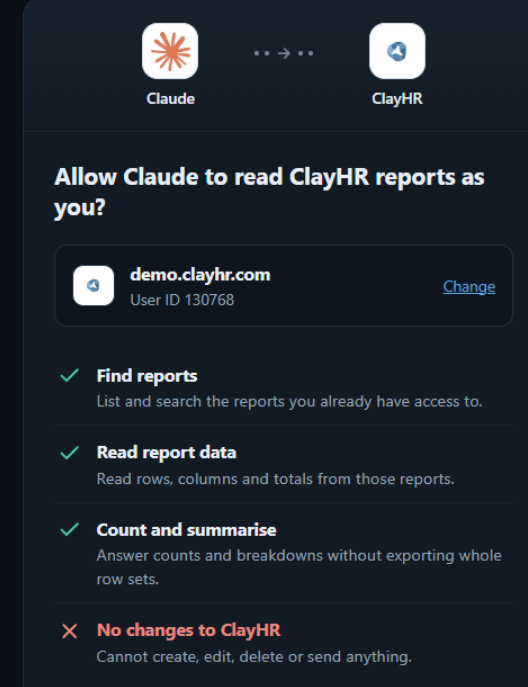
- Access is read-only. The authorization screen states this explicitly, and no configuration option changes it.
- Access can be revoked at any time, either by removing the connector in the AI assistant or by revoking the API key in ClayHR.
3. Before You Begin
Each user connects their own account. To complete the setup you will need:
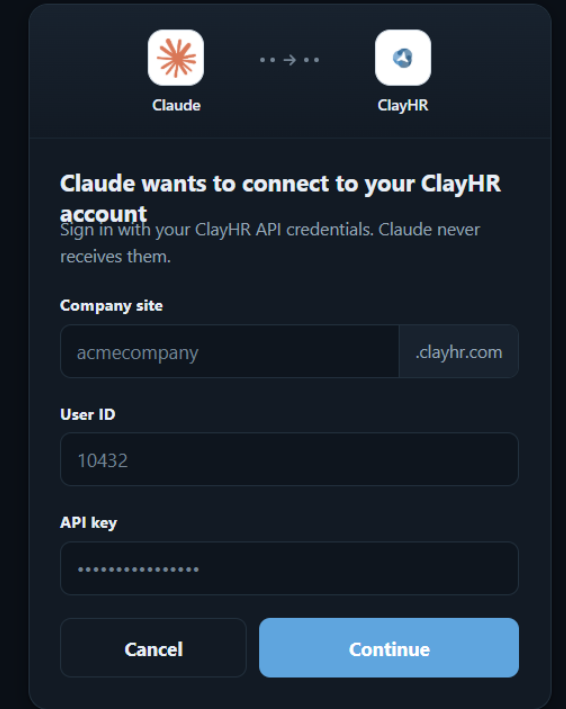
- Your company site name — the subdomain in your ClayHR address. If you sign in at acmecompany.clayhr.com, your company site name is acmecompany.
- Your User ID and an API key — both available in My Integration in ClayHR.
- A compatible AI assistant — Claude, ChatGPT, or another assistant that supports custom MCP connectors.
To generate your API key, navigate to My Integration in ClayHR, generate a new key, and copy it somewhere secure along with your User ID. The key is tied to your own account and carries your permissions, so it should not be shared.
4. Connecting Your AI Assistant
The steps below use Claude as the example. Other MCP-compatible assistants follow the same sequence, though menu names differ.
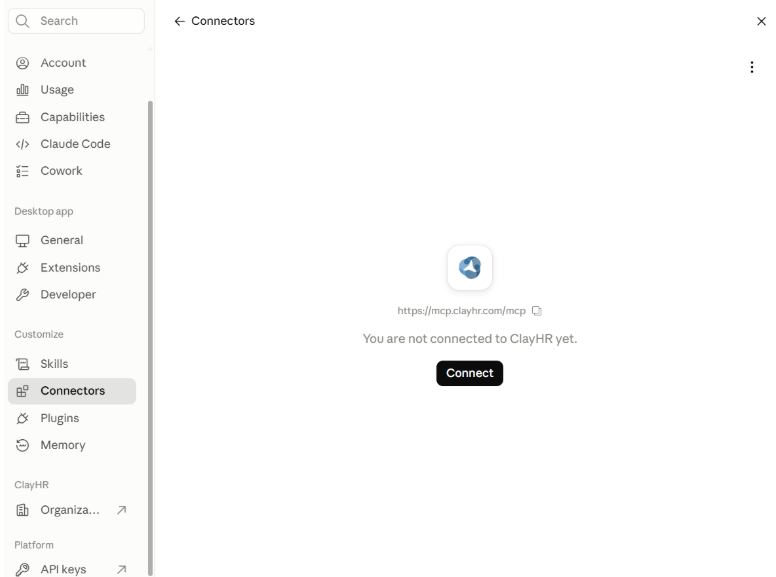
- In your AI assistant, open Settings and navigate to Connectors.
- Select Add custom connector.
- Enter the connector details:
- Name: ClayHR
- MCP Server URL: https://mcp.clayhr.com/mcp
- In the ClayHR sign-in window, enter your company site, User ID, and API key, then click Continue. All three values must be correct — if any one is wrong, the connection will fail and you will be returned to this window.
- Review the access being requested, then click Authorize. The screen confirms your company site and User ID, lists the three capabilities above, and states that no changes to ClayHR are permitted. If the company site or User ID shown is incorrect, select Change before continuing.
- Begin asking questions about any ClayHR data you have access to.
The connection persists until it is revoked, so this setup is completed once per user.
5. Common MCP Use Cases
- Employees — leave balances, upcoming review dates, assigned training
- Managers — team leave usage across quarters, compliance training status, current team goals
- HR Operations — payroll discrepancies, recruitment pipeline and applicant volumes, configuration and user group changes
- Leadership — headcount and workforce composition, engagement trends, hiring activity by location or business unit
Because MCP can only reach what a user can already open, confirm that the reports your teams rely on are shared with the people who need to query them.
6. Troubleshooting
ClayHR does not appear in the AI assistant's connector list
Confirm the connector was saved with the exact URL https://mcp.clayhr.com/mcp, then fully restart the AI assistant. Some AI assistants cache the connector list until relaunched.
The connection fails at the sign-in window
All three credentials must be correct. Check the company site field contains only the subdomain: acmecompany, not acmecompany.clayhr.com or the full web address. Then confirm your User ID, and that the API key was copied in full and has not been revoked. Regenerating the key in My Integration resolves most cases.
A permission error is returned
This reflects your existing ClayHR permissions. If you believe you should have access, ask your ClayHR administrator to review your report permissions.
The connection stops working
Remove the ClayHR connector in your assistant and add it again with the same details. If the problem continues, generate a new API key in My Integration and use it when reconnecting.
If the issue persists, contact ClayHR support at hello@clayhr.com.
.webp)