Managing Job Profiles
Job Profiles represent the job categories, designations, or functional levels that employees hold within your organization—such as Software Engineer, Sales Manager, HR Associate, or Director of Operations.
Setting these profiles up early ensures employees are consistently categorized, which supports permissions, workflows, job-specific analytics, career paths, skills mapping, and system-wide clarity.
Job Profiles are one of the three key context dimensions in ClayHR, alongside Org Units and Locations, and they form the backbone of many talent and HR processes across the system.
Note:
To learn more about the difference between User Profile, User Role, and User Group, please click here:
Difference between "User Profile" | "User Role" | "User Group"
IN THIS ARTICLE:
- Creating Job Profiles
- Why Job Profiles Matter
- Assigning Job Profiles to Users
- Method 1: One at a time
- Method 2: In bulk
- Method 3: via Import
- Best Practices for Managing Job Profiles
- (Optional) Adding Skills to Job Profiles
1. Creating Job Profiles
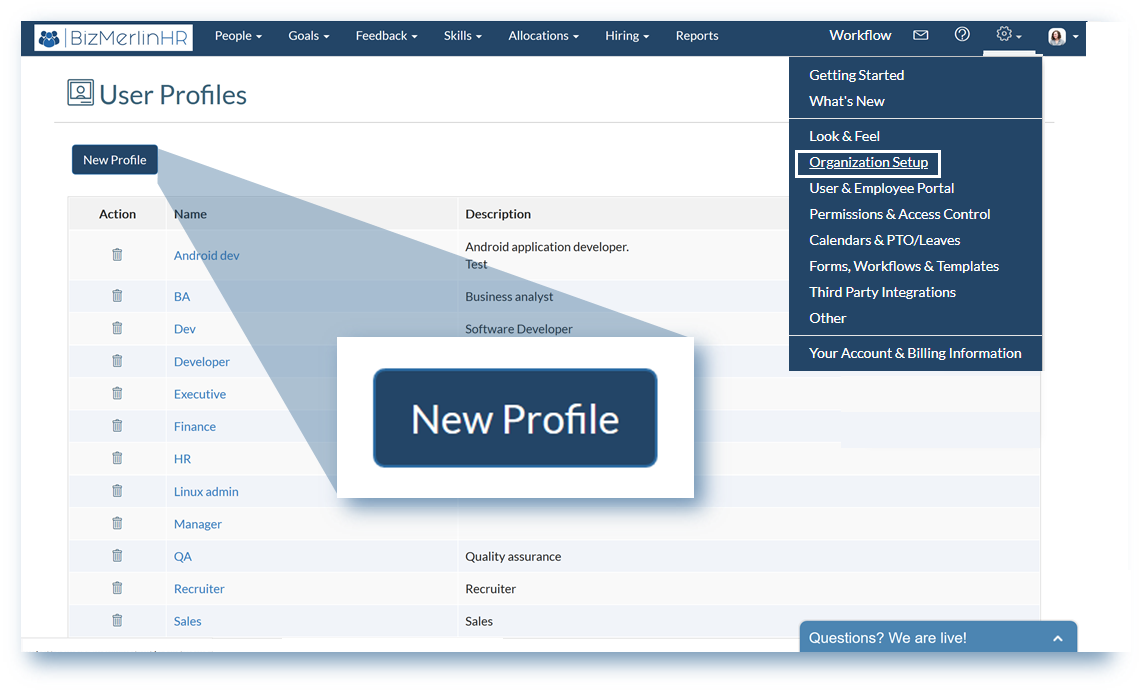
- From the top-right, click Set up.
- Select Organization Setup submenu
- Go to Job Profile tab
- Select Job Profiles link
- Enter the required fields,
- The following fields can be generated from scratch or with GenAI based on the Job Description Name:
- Description
- Responsibilities
- Requirements
- (Optional) Add recommended skills, job levels, competencies, or other details depending on your configuration.
- (Optional) Job Profiles can be enriched with Custom Fields
- Save your changes.
Your new Job Profile is now available to assign to employees.
2. Why Job Profiles Matter
Job Profiles are foundational because they help you:
- Standardize job definitions across the organization for clarity and consistency.
- Enable permissions and visibility, as many access rules can be tied to Job Profile groupings.
- Improve workflow routing, especially for onboarding, performance reviews, and other processes that depend on job type or job level.
- Support analytics and reporting, such as workforce distribution, turnover by job family, or compensation planning.
- Enhance ATS usage, since Job Profiles often map to position templates and external job board metadata.
- Define career paths and skills frameworks, enabling effective talent development.
- Streamline bulk actions, enabling fast updates based on job classification.
Job Profiles give structure and consistency across all talent-related modules in ClayHR.
3. Assigning Job Profiles to Users
You can assign (or reassign) users to departments in three different ways, depending on your needs.
- Assign one User at a time (through the Employee Record) - See instructions below
- Assign or update Job Profiles in bulk - See instructions below
- Assign Job Profiles via import - See instructions below
3.1 Method 1 — Assign One User at a Time (Through the Employee Record)
Use this method for individual updates or small adjustments.
- Navigate to People → Directory.
- Open the employee’s profile.
- Click Edit Person.
- In the Work Details section, select the appropriate Job Profile.
- Save your changes.
3.2 Method 2 — Assign or Update Job Profiles in Bulk
This is ideal for reorganizations or updating job categories across multiple employees at once.
- Go to People → Directory (or any filtered group list).
- Select multiple users using checkboxes.
- Click Bulk Actions.
- Choose Update Job Profile.
- Select the appropriate profile and confirm.
Bulk updates improve speed and consistency across the organization.
3.3 Method 3 — Assign Job Profiles via Import (New or Existing Users)
Use this method during onboarding or when updating large groups of employees.
3.3.1 Importing New Employees
Add a Job Profile column to your import template and specify the profile for each new user.
3.3. 2 Updating Existing Employees
- Export your user data.
- Add or modify the Job Profile column.
- Re-import the file via the Import module.
- ClayHR automatically updates the Job Profile assignments.
This method offers the cleanest and most scalable way to manage large job classification changes.
4. Best Practices for Managing Job Profiles
1. Design Job Profiles as Stable Reference Entities: Job Profiles should represent roles, not individuals. Avoid creating profiles that are too specific to a single person or temporary assignment. Instead, define profiles that can be reused over time, even as employees change.
Example:
- Use “Senior Software Engineer” instead of “Backend Engineer – Platform Team”
- Use “HR Business Partner” instead of “HRBP – Europe”
This ensures long-term consistency and cleaner reporting.
2. Align Job Profiles with Organizational Structure: While Job Profiles are distinct from Departments or Locations, they should still align logically with your organization’s structure.
Best practice is to:
- Define Job Profiles based on role and seniority
- Use Departments, Locations, and Reporting Lines to reflect organizational placement
This separation allows the same Job Profile to exist across multiple teams or regions.
3. Standardize Naming Conventions and Levels: Establish clear naming conventions for Job Profiles, especially when dealing with multiple seniority levels.
Examples:
- Analyst → Senior Analyst → Lead Analyst → Manager
- Engineer I → Engineer II → Senior Engineer → Principal Engineer
Consistent naming improves usability, reporting clarity, and integration with Career Pathways and Skills frameworks.
4. Use Job Profiles as the Foundation for Career Planning: Job Profiles work best when they are later connected to:
- Skills and competencies
- Career pathways
- Development and performance frameworks
Design profiles with growth in mind, so employees can clearly see progression opportunities across profiles and levels.
5. Review and Rationalize Profiles Regularly: Over time, organizations tend to accumulate redundant or outdated profiles.
Best practice is to:
- Periodically review existing Job Profiles
- Merge duplicates where possible
- Deactivate profiles that are no longer relevant
This keeps the system clean and prevents confusion when assigning profiles to users.
6. Limit Profile Creation to Designated Admins: To maintain consistency and governance:
- Restrict who can create or modify Job Profiles
- Centralize ownership within HR or system administrators
This avoids profile sprawl and ensures profiles remain aligned with organizational standards.
5. (Optional) Adding Competencies, Levels, and Skills to Job Profiles
ClayHR allows you to enrich Job Profiles with:
- Competency frameworks
- Required or recommended skills
- Certification requirements
- Job levels or seniority progression
- Performance expectations
This strengthens talent development, performance cycles, and skill alignment across roles.
[To learn more about the Difference between "User Profile" | "User Role | "User Group", please, click here]
.webp)